This guide explains the correct way to determine the top-up concentration for water-miscible coolants. Whether you are using synthetic, mineral oil, or ester oil based fluids, simply topping up with your original mix ratio every day is a mistake that leads to over-concentration.
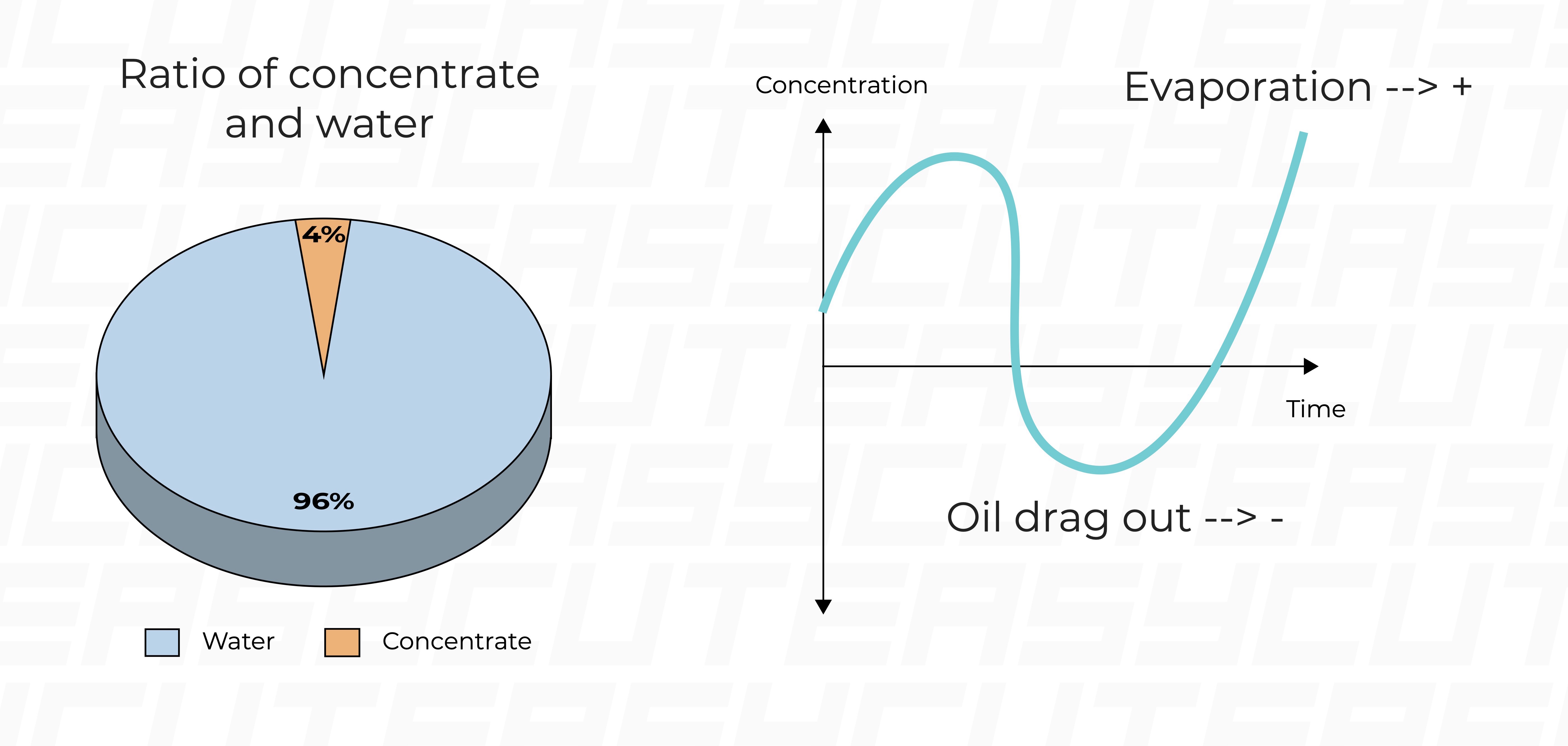
As your CNC machine runs, the mixture in the sump changes constantly. This is because the water component disappears much faster than the actual coolant concentrate:
Because the water leaves while the concentrate stays in the tank, the percentage of concentrate in the system automatically goes up. Your refractometer might show 10% even though you started at 8%. This is known as "concentration drift."
Many operators assume: "I want 8% in the tank, so I'll mix my top-up bucket at 8% too." This is mathematically incorrect.
If you add an 8% mix to a tank that has already drifted to 10%, the final result will still be well above 8%. You are essentially pouring expensive concentrate down the drain.
.png)
The goal is simple: You only need to add enough concentrate to reach your target (e.g., 8%) once the tank is full again. In the example above, you only need 10 more liters of concentrate to reach the required 80 liters (1000 L multiply by 0.08 = 80 L).
You mix those 10 liters into your 300 liters of top-up water. This makes your top-up concentration only about 3.3%.
Key takeaway: Your top-up mixture should almost always be much "thinner" than your initial fill ratio.
To save you from doing the math yourself, we’ve provided a dedicated tool. Just enter your current refractometer readings, and it will give you the correct mix ratio for your next top-up.
Check out the tool here: CNC Coolant Top-Up Calculator
Have questions about concentration control or need help with fluid maintenance? We are here to help you maximize the service life of your coolant.
