How well a coolant performs depends decisively on how correctly it is mixed. Water quality, coolant concentration and the way the emulsion is prepared determine how stable the fluid runs, how long the emulsion lasts and how reliably CNC machines keep working.
A badly set emulsion leads to foaming, corrosion, high consumption, unstable processes and shorter tool life. This guide explains step by step how to mix coolant correctly, what role water hardness and chloride content play, and how to set a stable emulsion reliably in practice.
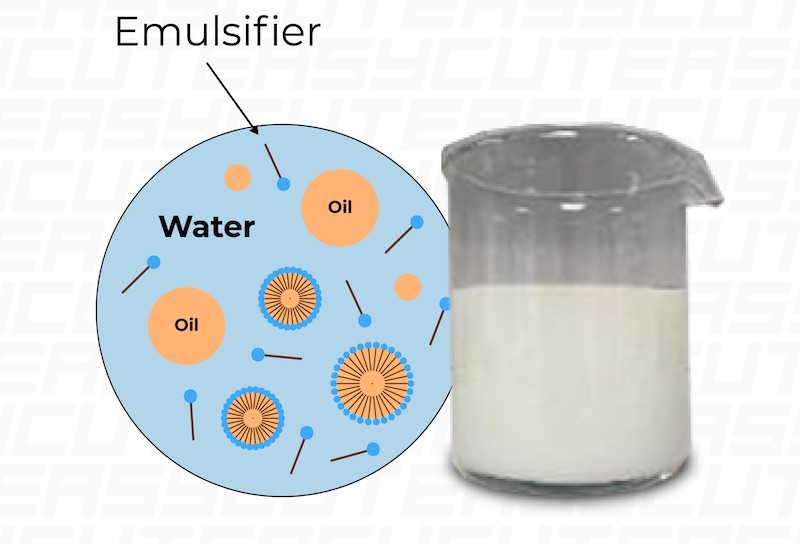
Figure: fresh coolant emulsion and the emulsifier principle
A coolant emulsion always consists of two main components: coolant concentrate and water. Water makes up more than 90 % of the finished emulsion by volume. That alone is why water quality has a direct effect on emulsion stability, on the actual coolant concentration and on how the fluid behaves in daily operation.
Water hardness, chloride content and cleanliness influence foaming, corrosion risk, machine hygiene, tool life and coolant consumption. Even a good concentrate cannot show its strengths if the water does not suit the application.
Good water gives a stable emulsion, an even concentration in the tank, longer service life and more reliable CNC processes. Poor or unchecked water causes unstable emulsions, constant readjustment of the concentration and avoidable disruption.
Water hardness describes the amount of dissolved minerals in the water, mainly calcium (Ca²⁺) and magnesium (Mg²⁺) ions. These ions react directly with the emulsifiers in the coolant and therefore affect emulsion stability, foaming and effective lubricity.
If the water is too soft, the emulsion can foam excessively, which brings air entrainment, pump problems and unstable concentration. If the water is too hard, poorly soluble compounds form — scale and so-called lime soaps. These deposit in the system, reduce corrosion protection and destabilise the emulsion.
Lime soaps form through the reaction between the anionic emulsifiers in the concentrate and calcium ions in the water. The effect shows directly in emulsion fineness, foam control and long-term service life.
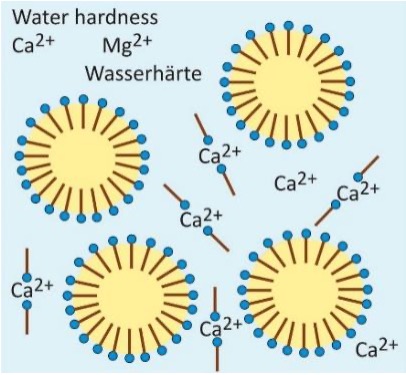
Figure: calcium and magnesium ions in water hardness
A coolant emulsion behaves differently in the tank depending on water hardness. Hardness affects foaming, emulsion stability, corrosion protection and the actual maintenance effort in daily operation. The following ranges serve as practical orientation:
Soft water (0–8 °dH)
Very soft water often leads to increased foaming, particularly at high pump pressures or with air turbulence in the system. Lubricity can become unstable, because the emulsion disperses more finely and reacts more sensitively to shifts in concentration.
Medium-hard water (8–14 °dH)
This range is considered optimal for most water-miscible coolants. The emulsion is stable, low-foaming and offers a good compromise between cooling, lubrication and corrosion protection. In this range, concentration and service life are the easiest to control.
Hard water (14–20 °dH)
As hardness rises, so does the risk of lime soap formation, deposits in the system and weakening corrosion protection. The emulsion can become unstable and needs more frequent maintenance and readjustment of the concentration.
Very hard water (>20 °dH)
Very hard water often leads to heavy mineral deposits, shortened emulsion life and increased maintenance. In such cases treated water or adapted coolant systems are strongly recommended.
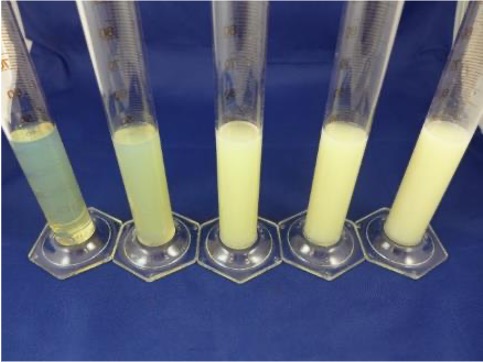
Figure: water hardness test strips and the 0–30 °dH scale
Water quality varies considerably by region in Germany and can differ markedly from town to town. A coolant that runs stably in one region can cause problems in another at exactly the same setting.
In southern Germany the water is often very hard, because of high mineral content in ground and spring water. Northern Germany is predominantly soft. Central and eastern Germany show a mixed picture with widely varying hardness levels.
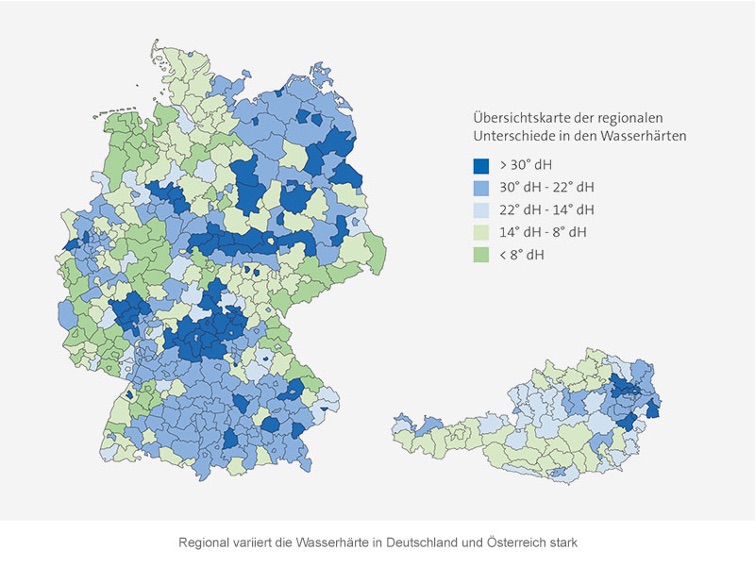
Figure: map of water hardness across Germany
Beyond hardness, chloride content also matters. It varies regionally as well and affects corrosion protection, emulsion stability and long-term service life. Some regions naturally show elevated chloride levels that have to be taken into account when preparing the emulsion.

Figure: map of chloride concentration across Germany
Because of these regional differences, shops should not work from blanket assumptions but know their local water values. Only when hardness and chloride are accounted for can a stable emulsion be held at a consistent concentration.
Chloride ions (Cl⁻) are another decisive factor for emulsion stability and for corrosion protection of machines and workpieces. Unlike hardness, chlorides act less visibly, but they can cause considerable damage over time.
Elevated chloride raises the risk of corrosion on machine parts, guideways, workholding and workpieces. At the same time the emulsion can become unstable and separate into oil and water phases over time.
Low chloride levels support longer emulsion life, stable corrosion protection and a more even concentration in the tank. High-alloy steels, aluminium alloys and fine precision components react particularly sensitively.
Where chloride is elevated, treated water — reverse osmosis (RO) or demineralised (DI) — can reduce the load considerably and improve emulsion stability.
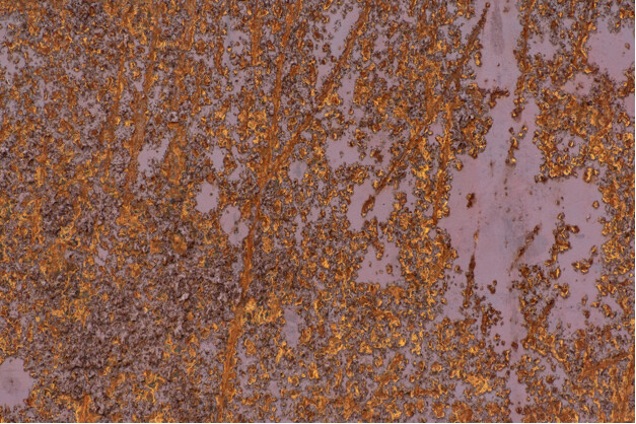
Figure: corrosion caused by a high chloride load
Even with optimal hardness and low chloride, an emulsion can become unstable if the system is dirty. Cleanliness plays a central role in service life, in the actual coolant concentration and in process reliability.
Rust particles, chips, abrasive debris, dirt and residues of old emulsions all act as catalysts for the breakdown of the coolant. They encourage microbial growth, shift the pH value and destabilise the emulsion over time.
Dirty tanks frequently lead to higher consumption, unpleasant odours, foaming and uneven concentration in the system. In practice, problems are often blamed on the coolant itself when the cause lies in the contaminated system.
Clean machine tanks, regularly cleaned mixing vessels and functioning filtration are therefore basic requirements for a stable emulsion and long service life. If a change is due anyway, it is worth cleaning the tank at the same time — how that runs is described in Cleaning a CNC machine.
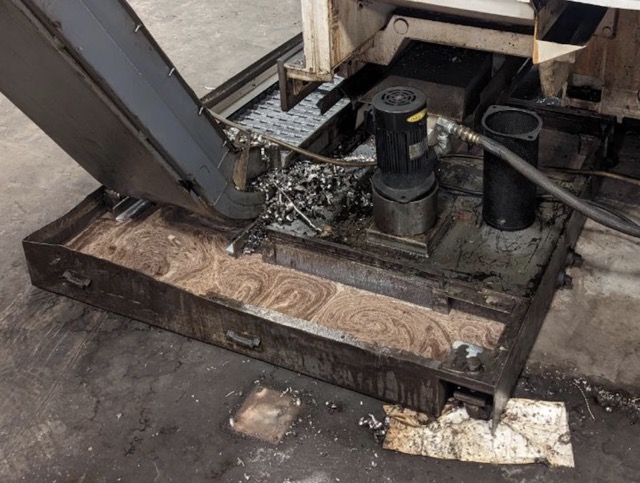
Figure: a contaminated coolant tank in practice
There are two ways to mix coolant: automatic mixing units and preparing the emulsion by hand. Both have their place, depending on consumption, plant size and process requirements.
Automatic mixers mount directly onto the concentrate container (canister, drum or IBC) and use water pressure to draw in concentrate and blend it with water. The finished emulsion goes straight into the machine tank or a storage vessel.
This gives even emulsion formation and a stable concentration, particularly at high consumption or across several CNC machines. The typical benefits are consistent quality, little operator influence and a reduced risk of mixing errors. A drum-mounted coolant mixer of this kind works in the 0–25 % range and can be run from a large container with an IBC adapter.
Manual mixing suits smaller shops, single machines or occasional top-ups. The quality of the emulsion then depends entirely on the operator.
Preparing by hand demands care, because errors in the ratio or in the order of mixing lead directly to unstable emulsions. The basic rule: always add concentrate to water, never water to concentrate.
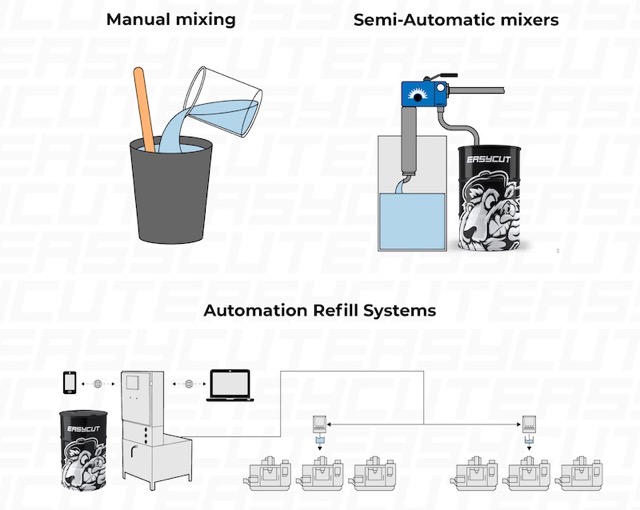
Figure: different methods of mixing coolant
When mixing by hand, a clean procedure is what produces a stable emulsion at the correct concentration. These steps have proven themselves in practice:
In daily operation the mix in the sump changes constantly, and always in one direction: water disappears faster than concentrate.
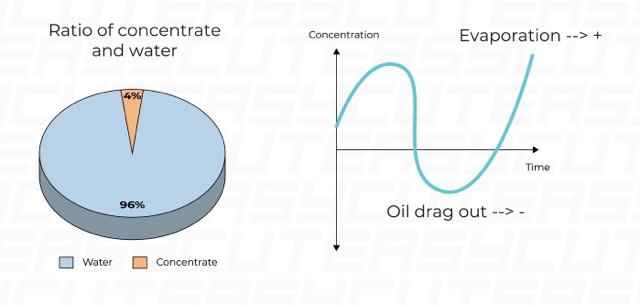
Because the water leaves and the concentrate stays, the proportion in the tank rises by itself. The refractometer then reads 10 % although the mix was set at 8 %. This concentration drift is not a measuring error, it is the normal case.
The most common mistake when topping up: "I want 8 % in the tank, so I will mix the top-up at 8 % too." That is mathematically wrong — topping up a mix that has already drifted to 10 % with an 8 % blend lands you above target again and pours expensive concentrate into a tank that does not need it.

The correct calculation works backwards from the target. At 1000 litres and 8 %, the tank should end up holding 80 litres of concentrate. Seventy are already there, so only 10 litres are missing. Those 10 litres go into the 300-litre top-up — which makes a top-up concentration of around 3.3 %.
As a formula, if you would rather calculate than follow the example:
top-up concentration = (V_target x c_target - V_actual x c_actual) / (V_target - V_actual)
The rule of thumb: the top-up mix is almost always considerably thinner than the initial fill. Setting both the same drives the concentration higher with every top-up, and everything that comes with it: skin exposure, foaming, residues and needless consumption.
The coolant calculator does the arithmetic for you: enter your refractometer readings and read off the mix ratio for the next top-up.
Many coolant problems come not from the product but from errors in mixing or maintenance. The following are among the most common causes of unstable emulsions and drifting concentration:
A stable, long-lasting emulsion is not luck but the result of correct mixing, controlled concentration and regular maintenance. The following have proven themselves in daily CNC operation:
Understanding water quality, emulsion and correct concentration is decisive for stable, economical CNC processes. Good water, correct mixing and clean systems cut consumption, prevent disruption and extend the life of tools and machines.
Which type of coolant suits your materials is covered in Types of metalworking coolant. Refractometers and mixing units are under Fluid Management.
You will find coolants for your application in our range:
